CONSENSUS
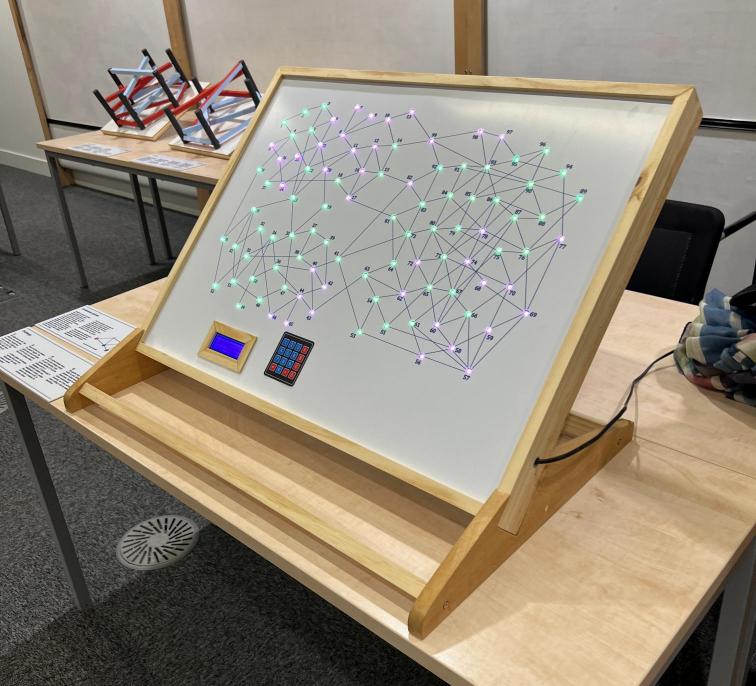
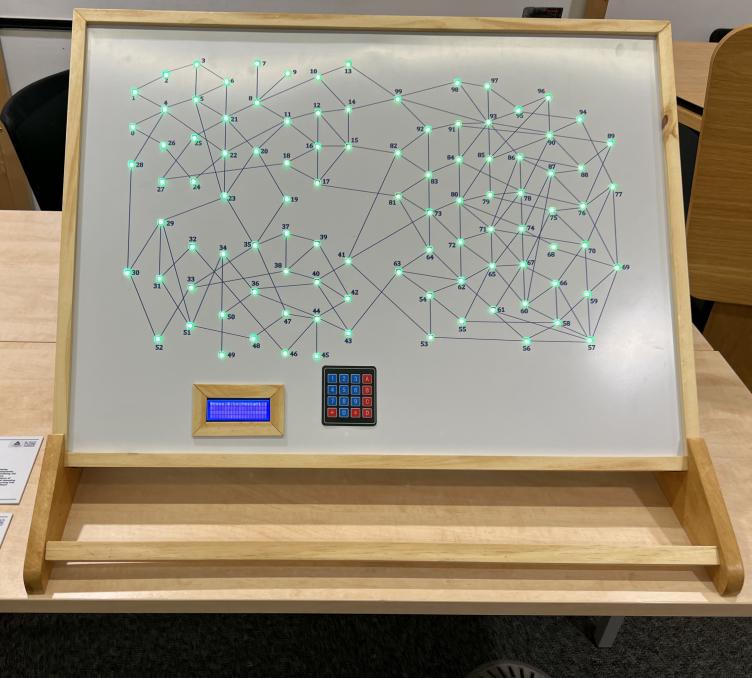
Imagine a group of robots. Each round, every robot independently decides to remain 'off' or select a colour. Once activated, they stay on permanently. To change colour, each robot first decides if it will be influenced by neighbours, then which neighbour. If that neighbour is off, the robot keeps its current colour; otherwise, it adopts the neighbour's colour. The game ends when all robots display the same colour.
We can represent this game as a graph, in which robots are nodes, and an edge between them represents that they are neighbours. What is the probability that a game ends with all robots showing a particular colour, e.g. green?
This problem has applications in autonomous systems that need to coordinate as a group while also making decisions independently.
The creation of this piece is a result of a partnership between Matemateca and King's College London
All lights start as off. Two players, each with their own colour, decide how many vertices to light up each (1, 2, or 3) at the start.
Once vertices are chosen, the 'game' begins. The game ends once all lights are lit in just one colour - that's the winning colour. A clever player will choose vertices that are more 'influential'. But what makes a vertex influential?